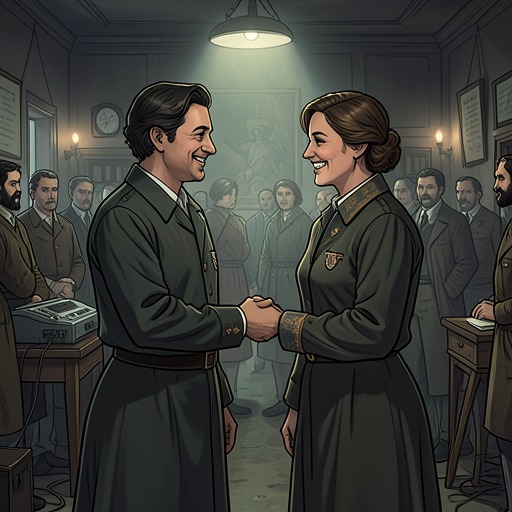
The Smiths’ six-week courtship
Mr. & Mrs. SmithThe Smiths’ six-week courtship compressed fear, attachment, and commitment into a relationship Jane expected to lose and John chose to formalize. They had met in Bogotá only six weeks earlier; by the time Jane feared their first elegant dinner might be a farewell, John was already in love and would soon ask her to marry him. The courtship’s defining contradiction is its speed: Jane saw six weeks as the point at which good things ended, while John treated the same short span as enough to know he wanted a shared life.
A deadline Jane expected
Jane measures the relationship against a pattern she believes is inescapable. She had never had a romance last beyond six weeks since beginning piano lessons in high school; even the longest had lasted only seven. Because what she and John had felt exceptionally good, she took its goodness as a reason to expect its end, not as evidence that it might endure. On the evening John invited her to a fashionable restaurant and told her to dress nicely, she feared he was about to break up with her.
That expectation shaped how Jane prepared for the date. She dressed as if there were something to celebrate, even while imagining that she might be toasting their goodbye. Her high heels made walking impractical, so John suggested taking a taxi. The small practical detail sits beside her larger unease: this is a romantic evening in prospect, but Jane approaches it as a possible last one. The six-week mark turns an ordinary invitation into a test of whether happiness can outlast the pattern she has known.
John’s commitment
John’s response to the relationship’s short duration is almost the reverse of Jane’s. The next day, while boxing with Eddie, he said he was in love. Eddie challenged the seriousness of that declaration by pointing out that John had known Jane for only six weeks. John struggled to explain what made her different, describing her as wild and strong and as someone who could match him. His account emphasizes not a quiet likeness but a sense of meeting an equal.
Eddie remained skeptical, treating sex as a routine appetite and predicting the relationship would last no more than six months. John answered by revealing that he had asked Jane to marry him. The proposal turns the six-week courtship from a fleeting romance into the beginning of a marriage, and makes the contrast between the men clear: Eddie judges the relationship by its duration and by his own casual assumptions, while John’s decision is already directed toward commitment. Jane’s fear of a breakup and John’s proposal occupy opposite sides of the same compressed timeline.
From courtship to domestic friction
The courtship’s rapid promise later meets the ordinary irritations of living together. In a grocery-store exchange, Jane points out that John has brought salted butter when she had asked for unsalted. John silently experiences the errand as an impossible assignment: he feels that she repeatedly gives him absurd shopping instructions and is never satisfied with what he brings back. He tries to apologize, but Jane waves the apology away and says she will think of something else. She then changes the subject to new living-room curtains.
The scene does not erase the earlier affection; it shows how little romantic certainty protects the couple from the mundane misunderstandings of marriage. John imagines himself as a tormented knight faced with an impossible task and Jane as an ice princess, turning a small domestic mistake into a private drama of failure and dissatisfaction. Her quick dismissal and shift to curtains leave the grievance unresolved rather than openly explored. In retrospect, the courtship’s intensity and the marriage’s routine friction are not separate stories: the couple who moved quickly toward a shared life must still learn how to manage its daily exchanges.
Intimacy amid danger
The narrative repeatedly sets intimate or domestic material against the couple’s violent professional world. In one passage, Jane addresses her client Marco Racin in a deliberately teasing voice, asking whether he has been a bad boy and prompting him to confess; the bed shakes as he nods. The encounter’s sexual playfulness belongs to Jane’s work, not to a disclosed episode in the courtship itself, but its proximity to the marriage plot underscores how the spouses’ private relationship exists alongside concealed and dangerous lives.
That collision becomes stark when John and Jane face an explosive threat. A small grenade drops from a ventilation opening and rolls across the floor; John recognizes that the toy-like object is real, not a joke. The couple’s story can pivot in an instant from marital tension to the possibility of death. The courtship’s short timetable therefore has a lasting narrative echo: the speed with which they chose one another is tested against a life in which domestic routines and lethal danger continually intrude on the same partnership.
A shared life under fire
During a later gunfight at home, John fires as he moves toward the dining room, shattering glass, opening cabinets, and striking Jane’s treasured teapot and its companion kettle. Jane pauses to take in the destruction of her favorite room, where appliances, cupboards, and decorations have been wrecked, before turning back toward John with a look of fury. The kitchen’s ruined objects give physical form to the damage their conflict does to the domestic life that began with their rapid courtship.
Yet the home is not simply a backdrop to their fighting. In a later escape from a store, John’s hand on Jane’s elbow directs her to move as agents secretly enter the building. They leap from a swing just in time, then pass a teddy-bear-filled playpen as the store’s armed, life-sized mascot, Homey, rises. Without hesitation, each shoots the mascot in its oversized padded head; its shotgun fires into the ceiling as it falls. What should have been a skirmish with an undercover agent becomes a public event. The scene makes the couple’s coordination visible through action: after the marriage has endured suspicion, domestic destruction, and danger, they move together under pressure.
The six-week courtship matters not because it guarantees an easy marriage, but because it establishes the speed and intensity of the choice the spouses must later keep making. Jane’s expectation that good things end is met by John’s proposal; the romance’s early certainty is then complicated by mundane resentment, secrecy, and gunfire. Across those contrasts, the courtship becomes the starting measure of their bond: brief in duration, consequential in commitment, and repeatedly tested by the life they build together.